






Donald Trump has always been the consummate salesman; one might say, a snake-oil salesman like nobody’s ever seen. Since the beginning of his second presidential term, he’s been branding himself as the face of the federal government, most notably in Washington, DC.
First, there was the rebranding of the United States Institute of Peace to include his name. Next came “The Donald Trump and the John F. Kennedy Memorial Center for the Performing Arts” (he did this without Congressional approval). Then came banners bearing his image festooning other federal buildings, including the Department of Labor and the Department of Agriculture headquarters. There have also been proposals to rename Dulles International Airport in his honor. He would be pleased.
He’s placed his name and image on other products as well, for instance, the Department of Homeland Security’s new Trump Gold Card. With this credit card, the well-to-do could give the country a $1,000,000 “gift” and jump to the front of the immigration line. The Department of the Treasury announced in December 2025 “Trump Accounts,” a tax-deferred plan that “provides a $1,000 government contribution for eligible children,” and the Interior Department introduced new designs for National Park passes featuring Trump’s image.
On February 19, 2026, workers were seen installing another banner outside the Justice Department’s Pennsylvania Avenue headquarters. This was concerning to many as a sign of authoritarianism, prompting questions about the agency’s independence.
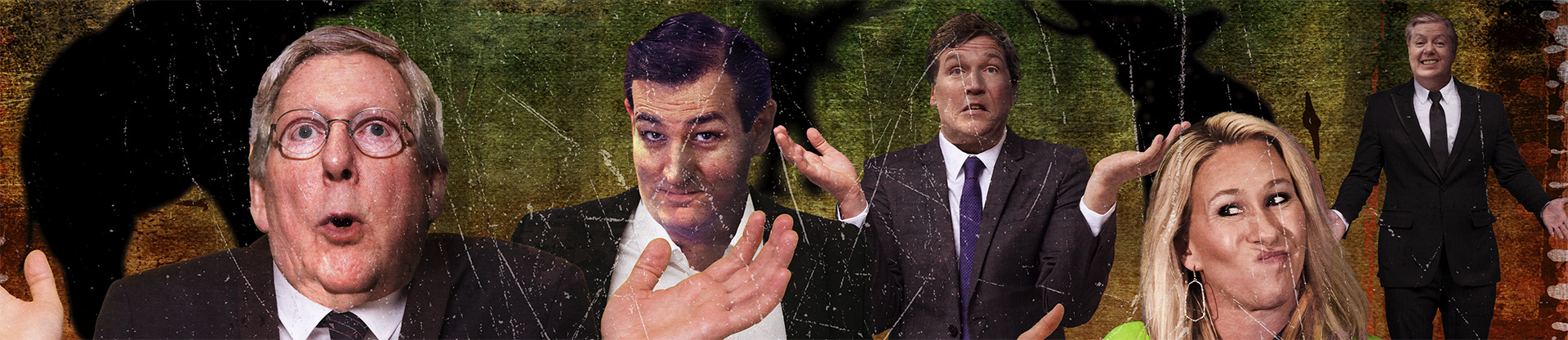
As a visual artist who has studied propaganda, I found Trump’s expression clear. “I am in charge! And I will determine the extent of my power, not the Constitution nor American citizens.” I decided an alternative message was in order. Replacing his image with a photomontage of the President I had created for my “Faces of the Republican Party” series and adding a verifiable quote from him about his duty to the Constitution seemed like the proper countermessage.